Why a Pre-Conference Review Matters
Unstructured attendance at large-scale computing events often yields weak networking outcomes. When data mining, communications, and machine learning tracks run simultaneously, showing up without a plan guarantees missed opportunities. This guide outlines a review sequence for attendees, authors, graduate students, committee participants, and applied computing professionals preparing for DMCIT 2024. Executing this preparation roughly three to four weeks prior to the event start date allows you to focus on four to six core preparation areas. The focus here remains strictly on preparation before attending the annual edition, rather than post-event publication management.
Start with the Edition Scope, Tracks, and Research Fit
Track themes and priority clusters shift significantly between annual editions. Reviewing the general historical archives of the conference provides less value than analyzing the specific call for papers for the current year. Start by mapping five to seven topical clusters relevant to your work, such as intelligent systems, machine learning scalability, or networked infrastructure.
From there, select two to three priority tracks. This narrows the field and prevents schedule bloat. Mapping your own research interests directly to these priority tracks ensures you spend your time in rooms where the hardware optimization and systems engineering discussions align with your current projects.
Read the Program as an Academic Map, Not a Timetable
Treat the schedule as a topological map of the field rather than a simple clock. Within a couple of days after the preliminary program release, examine the overarching structure. Identify keynote blocks, poster periods, workshops, panels, breaks, and registration windows before looking at individual talks.
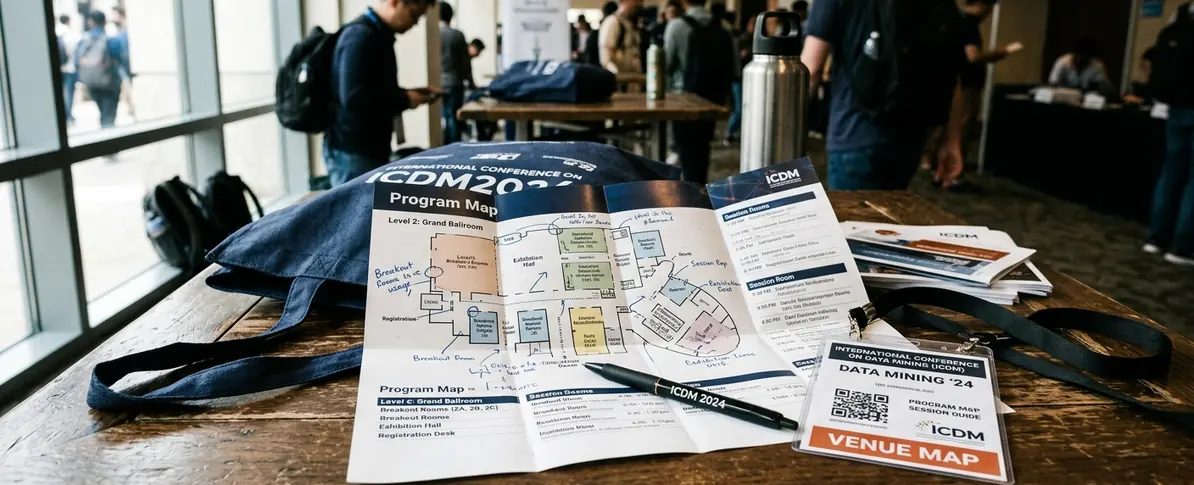
Attendees frequently report missing high-value technical sessions due to parallel track conflicts, especially when data mining and communications systems papers run at the same time. Build your schedule around non-negotiable anchor sessions first. Once those are locked in, you can navigate the three to four parallel technical sessions to fill gaps with secondary papers.
Review Accepted Papers with a Triage Method
Reading every accepted paper cover-to-cover is impossible. A three-pass triage method prevents you from getting bogged down in full-text reading. First, scan titles and abstracts to shortlist eight to twelve highly relevant abstracts. Second, allocate a strict 15- to 20-minute per paper allocation for targeted reading. Focus entirely on introductions, experiments, limitations, and conclusions.
Field Note: Pay special attention to papers that match your methodological assumptions, application domains, or infrastructure problems, not only papers from well-known institutions.
Note specific questions about reproducibility, evaluation design, deployment constraints, and comparison baselines before you walk into the room. This preparation transforms you from a passive listener into an active participant during the Q& A segments.
Check Presenter, Author, and Registration Requirements
Presenter obligations differ sharply from general attendee preparation. Authors face distinct compliance requirements, such as strict slide timing, poster dimensions, copyright forms, and specific file submission procedures. Confirm these details about ten to fourteen days before travel.
If you are presenting, verify the constraints of your 15- to 20-minute presentation slots, including onsite check-in rules. General attendees simply need to finalize session priorities. Be aware of varying visa documentation requirements based on the host country of the current annual edition, as these logistics can derail attendance if ignored. Requirements frequently change between editions, particularly concerning hybrid delivery formats or venue access.
Review Logistics Through the Lens of Participation
Basic travel booking is only the baseline. Logistical planning directly impacts intellectual engagement. Arriving 30 to 45 minutes before keynote blocks secures a vantage point for taking notes and identifying key speakers. Reserving 60 to 90 minutes for poster periods protects time for deep technical discussions without the pressure of rushing to the next room.
Confirm venue addresses, registration desk hours, session rooms, local time zones, meal arrangements, and emergency contacts early. Save offline copies of the program, your confirmation documents, and presenter files. Relying solely on venue internet access during peak registration windows is a proven point of failure for many attendees.
Credibility Signals to Review—and Their Limits
Official conference materials project authority, but they require contextual interpretation against recognized scholarly publishing principles. Review committee updates published within the last few months to understand the current governance structure. Look closely at organizing committee information, technical committee names, peer review descriptions, and institutional affiliations.
Cross-referencing two to three stated ethics policies against frameworks like the COPE Core Practices clarifies the review expectations.
Important: Committee presence signals governance for the current edition, but does not independently validate the empirical claims made in individual presentations.
Use these signals to gauge the rigor of the venue, not as a substitute for your own critical reading of the methodologies presented.
Prepare a Networking Plan Before the First Session
Spontaneous hallway interactions rarely yield lasting collaborations. Treat networking as a formal research activity. Start by identifying four to six key authors, session chairs, or committee members whose work intersects with your current ML scalability or systems architecture projects.
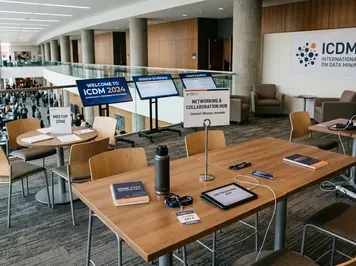
Prepare three concise discussion prompts per target. One prompt should address their methodology, another the application context, and the third future collaboration or data availability. This structured approach transforms brief encounters into actionable professional connections.
Final Pre-Attendance Checklist
Bridging scholarly review with operational readiness requires a consolidated approach. Building a one-page personal agenda three to five days before departure forces you to finalize your priorities. Use this time to verify five to eight critical logistical items, including presentation file formats, accessibility needs, and offline document availability.
Bottom Line: A single, accessible document containing your anchor sessions, target contacts, and logistical confirmations is the optimal tool for navigating the conference floor efficiently.