What's Inside
- Why a Strong Paper Still Needs a Submission Checklist
- Confirm the Call for Papers Fit Before Formatting
- Prepare the Manuscript Package: Format, Length, and Anonymity
- Check Research Integrity, Authorship, and Disclosure Requirements
- Make Code, Data, and Artifacts Reviewer-Ready
- Complete the Submission Portal Without Introducing Errors
- Scope and Limitations of This Checklist
- The Final 24-Hour Review: What to Verify Before You Click Submit
- Bibliography
Why a Strong Paper Still Needs a Submission Checklist
A brilliant algorithm cannot survive a desk reject. Many conference submissions fail before technical review begins because authors overlook avoidable administrative, formatting, anonymity, or artifact issues. I see this constantly when reviewing manuscripts for DMCIT 2024.
Structuring your preparation as a staged, multi-week pre-submission workflow is a proven method to systematically address these requirements. You should initiate this checklist workflow roughly two to three weeks prior to the submission deadline. Reserving the final days for writing often leads to disaster. Instead, allocate around two to three days specifically for formatting and anonymity checks.
This guide serves authors submitting to international academic conferences across computing fields, including data mining, communications, information technology, machine learning, software systems, and applied computing. Strict definitions govern paper format, blind review, supplementary materials, and ethics disclosures in these venues.
Confirm the Call for Papers Fit Before Formatting
Chairs strictly enforce page limits at 8 to 10 pages for full papers and 4 pages for short papers, excluding references. You must verify the exact Call for Papers version date directly on the conference website. Relying on cached announcements or initial emails is dangerous because track requirements frequently shift.
Conferences distinguish between full papers, short papers, posters, demos, workshops, doctoral symposium papers, and industry or application tracks. Each category carries different evaluation criteria. Check track updates about a week before submission to catch any late-breaking changes to the review model or language requirements.
Stop and evaluate your manuscript right now. The paper should clearly match at least one named track or topic area, not merely the broad conference theme.
Prepare the Manuscript Package: Format, Length, and Anonymity
Analysis of recent submission cycles suggests a harsh reality for careless formatting. Conference chairs rejected a manuscript without review because the PDF metadata contained the primary author's institutional affiliation, violating double-blind policies.
You cannot treat IEEE, ACM, Springer, or conference-specific templates as interchangeable. The current CFP and submission portal instructions override your habits from prior submissions. Enforce 0.75-inch side margins and 1-inch top and bottom margins. Set your body text to a 10-point minimum font size.
Important: Export a clean PDF build and open it on a secondary machine to verify that embedded fonts, tables, and equations render correctly outside your primary authoring environment.
Scrub your document for blind-review compliance. Remove author names, affiliations, acknowledgments, and grant identifiers where required. Delete self-identifying repository links and file names that reveal your institution.
Check Research Integrity, Authorship, and Disclosure Requirements
During multi-year research on publication ethics, we relied on the Committee on Publication Ethics as a general framework. However, the specific conference policy and your institution's rules govern the actual submission.
Map institutional ties and funding sources across all co-authors before drafting the manuscript to ensure accurate conflict of interest declarations. You must review roughly three to four years of prior collaboration or funding history for these disclosures. Secure ethics board approval dates prior to data collection, not after you write the results section.
Confirm your authorship list early. Ensure all listed authors made qualifying contributions, all contributors approve the submitted version, and author order is locked before you open the upload portal.
Make Code, Data, and Artifacts Reviewer-Ready
Artifact requirements are shifting from mandatory open-source code repositories in applied machine learning tracks to sealed, anonymized supplementary files in security-focused tracks. You must understand what counts as an artifact in your specific venue: source code, scripts, datasets, model checkpoints, configuration files, benchmark instructions, proofs, simulator settings, or experimental logs.
The ACM Artifact Review and Badging system provides excellent contextual authority for artifact expectations. Not every conference uses this exact badge system, but the underlying principles represent strong reviewer expectations.
Field Note: Isolate software dependencies into a dedicated environment file rather than listing them inline within the README to ensure automated reproducibility.
Specify exact random seeds, such as seed=42, for machine learning experiments. Document your hardware assumptions clearly, including requirements like a minimum of 16GB VRAM for model inference. Note any data access restrictions and expected runtimes.
Complete the Submission Portal Without Introducing Errors
Restrict your PDF file sizes to a maximum of 10MB to 20MB per file. Adhere strictly to the AoE (Anywhere on Earth, UTC-12) timezone deadline.
Allocate dedicated time to manually enter portal metadata to ensure exact matching with the PDF. This prevents last-minute truncation of abstracts or missing co-author details. Title changes or inconsistent abstracts create administrative confusion that delays the review process.
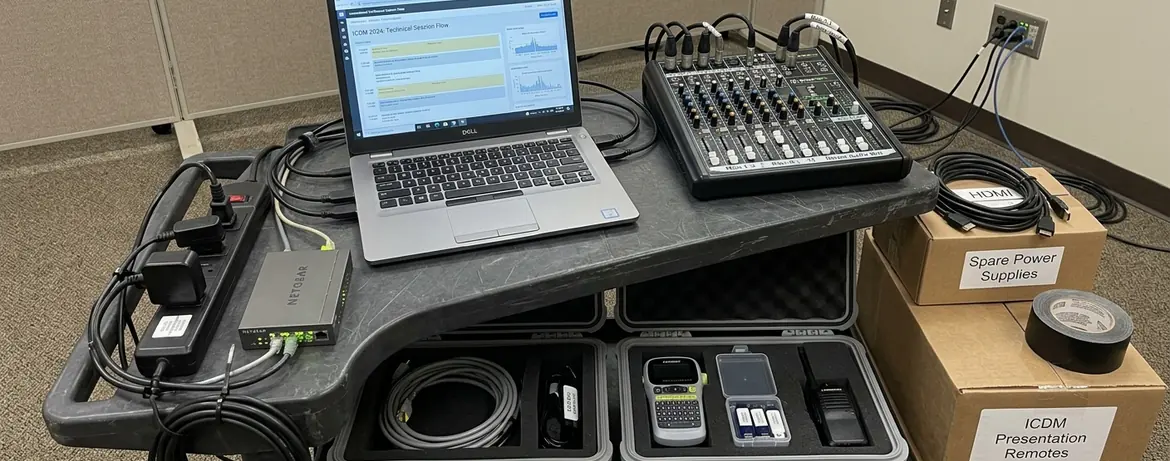
Map your final upload workflow step-by-step. Enter the title, abstract, keywords, subject areas, and track selection. Add author details, affiliations, and conflicts. Upload the correct camera-ready versus review version, ensuring no accidental draft watermarks remain.
Scope and Limitations of This Checklist
This guide provides a general submission workflow for international computing conferences. It is not a substitute for the official CFP, publisher template, or submission system instructions. Policies vary wildly across IEEE-sponsored events, ACM conferences, Springer proceedings, independent academic meetings, and workshop series.
You must differentiate artifact needs based on your subfield. Data mining tracks expect raw datasets, while theoretical IT tracks demand mathematical proofs. Consult local institutional review boards for export control regulations, data protection, and medical research requirements.
One catch—this workflow assumes standard double-blind peer review and does not fully cover open-review models where author identities and reviewer comments are published concurrently.
The Final 24-Hour Review: What to Verify Before You Click Submit
Assign specific verification roles among co-authors to prevent single-point-of-failure oversight during the final upload phase. One person checks CFP compliance, one checks PDF build quality, one checks references, and one checks portal metadata.
Conduct the final portal check roughly half a day before the AoE deadline. Download the submitted PDF directly from the portal to verify an exact byte-for-byte match with your local file.
Bottom Line: The strongest submissions make the reviewer's job easier by removing avoidable uncertainty around scope, evidence, and compliance. A guaranteed way to frustrate a reviewer is to make them hunt for missing dependencies or decipher broken formatting.