What the DMCIT Scope Review Is Really Checking
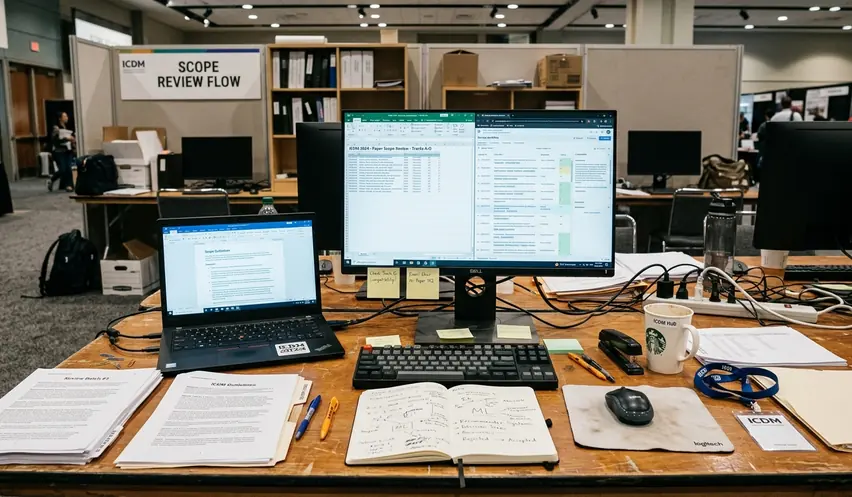
A scope review is triage, not a miniature peer review. It asks one blunt question first: does this manuscript belong within the International Conference on Data Mining, Communications and Information Technology before reviewers spend time on deep technical merit?
That distinction matters for DMCIT 2024. A paper can contain competent experiments, careful notation, and a usable dataset, yet still miss the conference if its central problem sits outside data mining, communications, information technology, machine learning, machine vision, or applied computing systems. I treat scope as the paper’s first argument. If the abstract cannot make that argument, the methods section rarely rescues it.
For DMCIT 2024, the immediate planning dates were tight: the extended full paper submission deadline was March 25, 2024, and the extended notification of acceptance was April 10, 2024. Those dates leave little room for late conceptual repair. Authors need to establish topic fit before polishing equations, tables, or camera-ready phrasing.
Bottom Line: Scope review checks conference alignment before technical depth. A strong DMCIT paper makes its field visible in the title, abstract, introduction, and evidence plan.
Map the Manuscript to DMCIT’s Research Lanes
Choose the lane before choosing the language
DMCIT’s topic areas give authors a useful map: Data Pre-Processing, Statistical Learning Theory, Data Stream Mining, Machine Vision and Information Technology, Optical Communications, DSP Algorithms & Architectures, and Biometric Identification Technology. These are not decorative labels. They tell a reviewer what kind of contribution to expect.
Broad terms weaken that signal. “AI for safety,” “big data platform,” or “information systems framework” can describe almost anything. A paper on image classification, for example, becomes much easier to place when the author states that the contribution is a preprocessing method for low-quality visual inputs, a feature construction scheme, or a deployment constraint in a machine vision pipeline.
For data mining papers, name the pipeline stage. Use terms such as preprocessing, feature construction, stream handling, model evaluation, or deployment constraint. A generic image-classification manuscript with no defined preprocessing method or system constraint looks thin at scope review because the reviewer cannot tell whether the work advances data mining, machine vision, or merely applies an existing model.
Do not let templates carry the argument
Formatting can help a manuscript look familiar, but it cannot define the research lane. Historical APISE template formatting guidance from 2019 may still influence author habits, yet topic fit must come from the manuscript’s claims. Put the lane in the abstract, repeat it in the introduction, and use the same vocabulary when describing experiments.
Turn the Contribution into Reviewable Evidence
A scope-fit claim becomes stronger when the manuscript connects it to evidence. The evidence may be algorithmic design, an experimental setup, simulation, modeling, optimization, parameter search, or system evaluation. The key is to tell reviewers what kind of technical object they are judging.
Here is the distinction I look for: the method contribution should stand apart from the application demonstration. If a paper uses federal aviation accident and incident records, the dataset may be appropriate, but the manuscript still needs to explain what the computing contribution is. Does it improve feature construction? Does it model event patterns? Does it optimize a classifier under a specific constraint? Proper citation and methodological fit matter as much as the appeal of the source material.
Use special-session language when it is accurate
The DMCIT special session topic Simulation, Modeling and Optimization gives authors a useful fit signal when the work depends on modeled systems, parameter search, or performance trade-offs. Do not force that label onto every experiment. Use it when simulation or optimization is central rather than incidental.
The abstract should state the research question and contribution in field-specific language. “We propose a stream-mining method for delayed sensor events” tells reviewers more than “we present an innovative intelligent platform.” Promotional language sounds confident, but reviewable language travels farther.
Field Note: If you can delete the application domain and the contribution disappears, the paper may be an application report rather than a DMCIT research paper.
Submission Timing, CMT Upload, and Peer-Review Expectations
Separate workflow from judgment
DMCIT 2024 papers are submitted electronically through CMT. Authors who need the platform entry point can use the Microsoft Conference Management Toolkit, while [email protected] serves as the primary submission and contact email in the conference workflow.
The expected peer-review duration is roughly 20 to 30 days. Treat that as a planning window, not as a fixed reviewer schedule or a signal of outcome. Peer review evaluates quality. Scope review decides whether the paper belongs in the technical program in the first place.
I recommend using the final pre-deadline window, around the last two days, for metadata and file version checks. Confirm the paper title, author order, affiliations, abstract, keywords, topic selections, and uploaded file. A routing error at this stage can make a relevant manuscript look careless before anyone reads its method.
Presentation rules are not submission rules
Older presentation-format details, such as 2018 slide decks requiring Arial or Times New Roman, belong to presentation preparation rather than manuscript scope. Do not confuse them with the research paper upload. The CMT record, manuscript file, and topic metadata do the practical work during initial triage.
Quality, Ethics, and File Controls Before Submission
Plagiarism is prohibited conduct and may trigger institutional reporting. Authors should cite reused text, avoid self-plagiarism, quote sparingly, and confirm that every figure, table, dataset, and code reference can be used in the paper. A duplicated literature review is not harmless filler; it raises provenance questions before the contribution gets a fair reading.
Ethical preparation is part of scope credibility. A paper with unexplained data sourcing, copied background sections, or ambiguous figure permissions asks reviewers to trust material the authors have not documented. That trust is hard to regain inside a short conference review cycle.
Format as technical compliance
Formatting is not cosmetic. Authors using LaTeX should verify template compatibility, bibliography output, figure placement, mathematical notation, and file compilation before upload. If a PDF conversion tool or IEEE PDF eXpress-style validation step is part of the preparation path, check font embedding, margins, and symbol rendering before the manuscript reaches the program committee.
This is where many otherwise careful papers lose clarity. A broken reference list makes a statistical learning paper look unfinished. A cropped architecture diagram can hide the DSP pipeline the paper needs reviewers to evaluate. A misplaced table can bury the only direct comparison in the study.
Important: File validation should happen before the deadline, not after upload. The March 25 deadline is a submission boundary, not a debugging session.
Scope Boundaries: What Belongs Elsewhere or Needs Reframing
Not every computing-adjacent paper fits DMCIT. A manuscript centered on pure business management, policy commentary, or nontechnical education practice may need reframing around data mining, communications engineering, or information technology systems. Without that technical anchor, the paper belongs elsewhere even if it uses computing vocabulary.
ACPEE 2026 is a useful boundary example. It is a Power and Electrical Engineering conference with IEEE PES involvement, enterprise attention to power quality, CMT Submission System use, and senior-management networking such as a VIP dinner. Those details make it relevant as a comparison, not as a substitute for DMCIT topic scope.
Infrastructure engineering versus computing methodology
A power-quality paper may fit ACPEE when it focuses on grid equipment, electrical reliability, or enterprise energy systems. The same broad problem might fit DMCIT only if the manuscript centers on data mining, communications protocols, signal processing algorithms, or information technology architecture. The venue changes with the technical claim.
One catch: this preparation guide supports alignment for the initial scope review phase but does not guarantee final acceptance, IEEE Xplore-related processing, indexing treatment, or presentation format approval. Deadlines, CMT submission, peer review, plagiarism handling, PDF eXpress-style checks, FAA source materials, APISE templates, and adjacent conference examples all help authors prepare; none replaces the program committee’s judgment.
Final Scope-Review Checklist for Authors
Use the final pass to test visibility. The reviewer should not have to excavate the contribution from page six.
- Select one primary DMCIT topic lane.
- Align the abstract with DMCIT fields rather than generic AI or big-data phrasing.
- State the contribution in technical terms.
- Name the evidence type: algorithmic design, experiment, simulation, modeling, optimization, parameter search, or system evaluation.
- Make the methodology reproducible enough for review.
- Complete citations for datasets, code, prior methods, figures, and reused text.
- Check plagiarism and self-plagiarism risk.
- Validate the manuscript file, especially fonts, margins, figures, equations, and bibliography output.
- Confirm CMT metadata, author order, keywords, and topic selections.
- Complete the CMT upload before the March 25 deadline.
Ask one colleague outside the author team to read only the abstract and introduction. Then ask a narrow question: is the DMCIT fit obvious before the experimental section begins? If the answer requires a verbal explanation, revise the manuscript rather than the cover note.
Bottom Line: A DMCIT-ready paper makes its technical field, contribution, and review evidence unmistakable before the reviewer reaches the experimental section.