Why CFP Theme Patterns Matter
Call-for-papers themes do a practical job: they translate a conference's intellectual scope into submission-ready categories.
For researchers, graduate students, program committee members, and organizers, that translation matters before a manuscript ever reaches peer review. A paper on graph anomaly detection, for example, can look like algorithmic data mining, network security, or applied information systems depending on how the contribution is framed. The CFP gives authors a first map of where the work belongs.
DMCIT 2024 sits in that kind of cross-disciplinary space: data mining, communications, and information technology overlap, but they do not collapse into one topic. Review cycles commonly run over several months, and program committees often sort through hundreds of submissions in a cycle. Clear thematic alignment helps at the first triage stage, before reviewers debate novelty or empirical strength.
This article is not a prediction of acceptance. It is a curated map of recurring scholarly topic families often seen in computing conference calls.
What's Inside
- How CFP theme patterns help authors position a paper.
- The selection criteria behind this curated list.
- The scope and limits of using topic families for conference planning.
- Eight common CFP themes across data mining and information technology research.
- Concise takeaways and source references for further framing.
Criteria for Selecting These CFP Themes
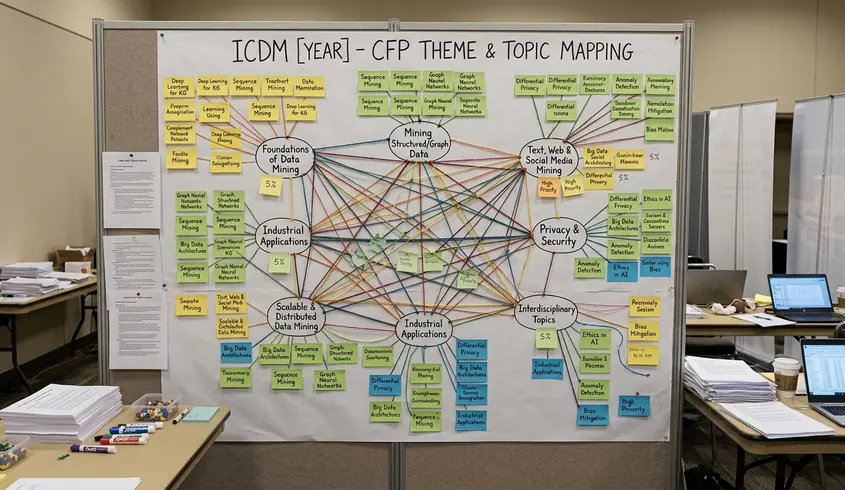
I selected themes by asking three practical questions: does the topic belong to data mining, communications, information technology, machine learning systems, applied computing, or evaluation practice; does it survive beyond one fashionable phrase; and does it help an author decide how to frame the paper?
When curating this taxonomy, I initially considered organizing themes by funding agency priorities, but ultimately discarded that approach because regional grant cycles fluctuate too rapidly. A CFP taxonomy needs to hold still long enough for authors to use it. The ACM Computing Classification System, comprehensively updated in 2012, provides a useful reminder of scale here: it organizes computing into a hierarchy with over 2,000 distinct concepts. A CFP cannot mirror that entire structure, so it compresses scholarly territory into broader submission lanes.
Topical durability matters. A durable CFP theme usually persists across several annual cycles before it needs serious reclassification, while a short-lived phrase may disappear before a doctoral student finishes the related study.
Field Note: I trust CFP themes most when they name the research contribution, not the tool. A paper framed around scalable stream mining will age better than one framed only around the current orchestration platform.
Submission usability matters just as much. Each theme below should help authors identify where to foreground methodology, datasets, systems, application context, or evaluation design. CFP language still shifts with each committee's local vocabulary, so treat the categories as a positioning aid rather than a universal ontology.
Scope and Limitations of This Curated List
This list covers common CFP themes, not every possible subfield in data mining or IT.
I avoid ranking topics by popularity, funding level, or acceptance likelihood because no named dataset supports those claims here. In highly competitive data mining venues, acceptance can be selective, but topical fit alone never carries a weak paper. One catch: aligning perfectly with a CFP theme does not bypass the requirement for methodological rigor; program committees will still reject submissions that lack robust empirical validation, regardless of topical fit.
The list works best during initial paper-positioning decisions. Final fit depends on the official CFP, track descriptions, submission rules, and reviewer expertise for a given conference year. Authors should read the current track text line by line, especially when a venue such as DMCIT 2024 spans both information systems and applied computing.
Common CFP Theme Families in Data Mining and IT
1. Scalable Data Mining Algorithms
This theme covers algorithms for classification, clustering, association analysis, anomaly detection, graph mining, stream mining, and high-dimensional pattern discovery. The shared concern is scale: can the method preserve accuracy, interpretability, or pattern quality while computational demand rises?
CFPs in this area usually expect methodological novelty, computational efficiency, comparative evaluation, and a clear problem formulation. A submission should not merely report that an algorithm runs faster. It should explain why the design changes the search space, reduces memory pressure, improves convergence behavior, or supports a harder data regime.
The definition of scalability shifts drastically depending on the track; in big data engineering, it refers to distributed node throughput, whereas in algorithmic data mining, it refers to computational time complexity.
Important: A purely theoretical algorithm submitted to an applied case-study track will struggle if it lacks real-world domain validation or deployment constraints.
2. Machine Learning and Deep Learning for Complex Data
Machine learning themes usually sit close to data mining, but they lean toward model design and representation learning. CFPs often group supervised, unsupervised, semi-supervised, self-supervised, and reinforcement learning methods under this heading when the data are structured, textual, visual, temporal, or multimodal.
The useful distinction is contribution type. A data mining paper may emphasize pattern discovery or efficient extraction. A machine learning paper more often emphasizes architecture, training strategy, loss design, generalization behavior, or evaluation under realistic constraints. For deep learning submissions, reviewers will look for disciplined baselines and credible ablations, not just a larger model.
Complex-data papers also need sharper evaluation language. A multimodal clinical notes project, for instance, should specify whether the novelty lies in aligning modalities, reducing annotation burden, handling missing signals, or improving downstream prediction. Those are different CFP stories.
3. Big Data Engineering and Distributed Information Systems
Big data engineering begins with a different premise: the system is part of the research object. Distributed storage, data pipelines, large-scale indexing, stream processing, cloud-based analytics, workflow orchestration, and database-backed information systems all belong here when implementation depth drives the contribution.
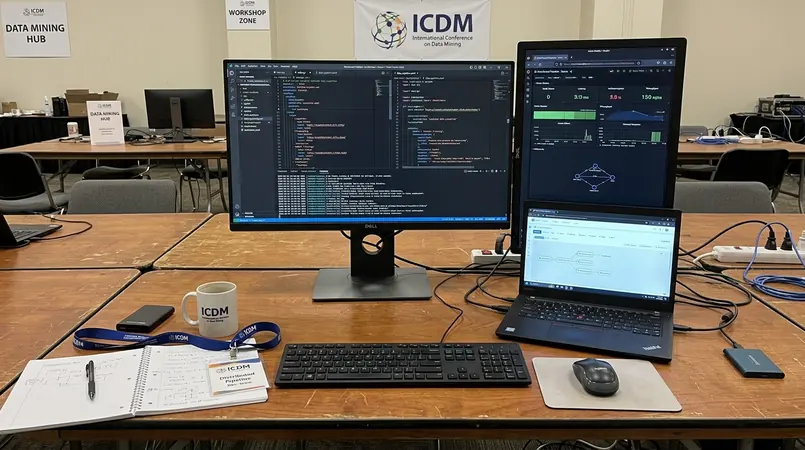
These CFPs value architecture. Authors should explain partitioning decisions, fault handling, latency behavior, reproducible deployment context, and the trade-off between throughput and consistency. A strong paper in this theme reads less like a model report and more like a systems argument with evidence.
There is room for algorithms, but the algorithm must live inside the operating conditions of the system. If the paper claims real-time analytics, the evaluation should report latency and workload behavior in terms the systems track can inspect.
4. Privacy, Security, and Trustworthy AI
This theme covers privacy-preserving data mining, secure communications, adversarial learning, federated learning, data governance, explainability, fairness, accountability, and risk management. It has grown because data mining systems no longer sit apart from institutional risk.
The NIST AI Risk Management Framework, published as AI RMF 1.0 in January 2023, gives useful terminology through four core functions: Govern, Map, Measure, and Manage. I would not treat that framework as a substitute for a conference's own track language, but it helps authors name risk-oriented contributions with more precision.
Federated learning, for example, can be framed as privacy-preserving machine learning, distributed optimization, secure systems, or trustworthy AI. The correct framing depends on whether the contribution lies in aggregation, threat modeling, communication efficiency, auditability, or empirical robustness.
5. Communications Networks, IoT, and Edge Computing
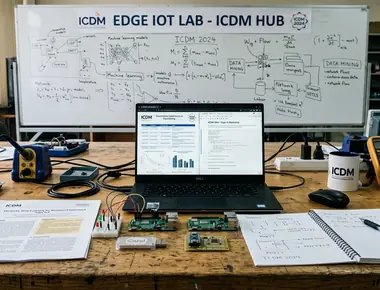
Communications and data mining meet wherever networked devices generate telemetry. Wireless networks, sensor systems, network analytics, edge intelligence, mobile computing, communication protocols, cyber-physical systems, and Internet of Things applications all fit this family when the research links infrastructure behavior to computational analysis.
The edge case is literal here. Devices may face tight power budgets, intermittent connectivity, and limited memory while still needing anomaly detection, resource allocation, or security monitoring. A paper that ignores those constraints may look impressive in a lab trace and thin in a communications track.
Network analytics submissions benefit from a precise statement of what gets mined: packets, flows, device logs, routing events, radio measurements, or application telemetry. That choice determines the evaluation design.
6. Information Retrieval, NLP, and Knowledge Discovery
This family includes search, ranking, natural language processing, semantic indexing, knowledge graph construction, entity resolution, recommender systems, and text mining. It often appears in CFPs because much of modern information technology depends on retrieving or structuring unclean information.
The contrast with general machine learning is useful. An NLP paper may introduce a model, but an information retrieval paper must also confront ranking behavior, query intent, collection bias, and user-facing relevance. Knowledge discovery adds another layer: entities, relations, ontologies, and provenance need to survive inspection beyond aggregate scores.
For this theme, the best submissions do not hide behind a single metric. They explain why the evaluation setting matches the information need.
7. Applied Computing and Domain Case Studies
Applied computing themes ask a blunt question: what changes when the method enters a domain with constraints, stakeholders, and messy data? Healthcare informatics, smart manufacturing, education technology, environmental monitoring, transportation systems, digital finance, and public-sector analytics frequently appear under this heading.
A case study is not weaker than a methods paper; it is accountable to different evidence. The manuscript needs domain motivation, data provenance, deployment assumptions, and validation that domain readers can interpret. In healthcare informatics, for example, seasonal effects, coding practices, and institutional workflows can shape the data as much as the algorithm does.
Authors should resist the temptation to oversell generality. A carefully bounded manufacturing analytics study may contribute more than a sweeping claim that never leaves one production line.
8. Evaluation, Reproducibility, and Benchmarking
This theme belongs in more CFPs than it receives credit for. Benchmark design, replication studies, artifact packaging, comparative evaluation, metric selection, workload characterization, and reproducible experimental environments all shape whether a research claim can travel.
The ACM Artifact Review and Badging guidelines, Version 1.1 updated in 2020, define three levels of artifact recognition: Available, Evaluated, and Reproduced. That structure gives authors a vocabulary for describing how far their artifacts support verification.
Evaluation papers can feel unglamorous until a field needs them. Then they become infrastructure. In comparative data mining, a well-designed benchmark may clarify three years of scattered claims faster than another marginal model variant.
Summary Takeaways
Bottom Line: CFP themes help authors position a contribution, but they do not replace methodological rigor, evidence quality, or careful reading of the official call.
- Use scalable data mining when the core contribution is algorithmic efficiency, complexity, or pattern discovery under demanding data conditions.
- Use machine learning and deep learning when model design, representation learning, training strategy, or realistic evaluation constraints define the paper.
- Use big data engineering when architecture, deployment, latency, reliability, and distributed operation carry the research claim.
- Use privacy, security, and trustworthy AI when risk, governance, adversarial behavior, fairness, explainability, or protected computation sits at the center.
- Use communications, IoT, and edge computing when telemetry, protocols, devices, and constrained network environments shape the research problem.
Before submission, align the abstract, keywords, contribution statement, and experimental framing with the chosen theme. A precise abstract can make the difference between an easy reviewer assignment and a confused first read.