Why Communications and Network Systems Matter in a Data-Centric Conference
Communications and network systems are not separate from data mining and information technology—they shape how data is collected, transported, protected, synchronized, and acted on. When we evaluate submissions for DMCIT 2024, we look for research that acknowledges this fundamental relationship. A brilliant machine learning model falls apart if the underlying wireless infrastructure cannot deliver the necessary telemetry within strict latency bounds.
During the study of past conference cycles, analysis of roughly 400 past submissions between 2019 and 2023 helped the program committee determine track boundaries. We identified a clear need to explicitly link physical layer transport with upper-layer applications. This article serves a practical purpose: helping authors, reviewers, graduate students, and organizers understand exactly which network-oriented submissions fit our scope.
We position this track to welcome both theoretical systems research and applied computing deployments. Whether you are investigating wireless infrastructure, distributed platforms, edge environments, or security-aware communications, the goal is to demonstrate how network mechanics enable broader computing objectives.
Core Topic Areas: From Protocols to Networked Applications
Rather than relying on a generic list of networking terms, organizers categorized the core topics by mapping accepted papers to established taxonomy clusters. This ensures reviewers with specific expertise in areas like IoT or multimedia transmission are assigned appropriately. The primary clusters include network protocols, wireless and mobile systems, IoT communications, cloud-edge networking, network security, multimedia transmission, and performance engineering.
A strong academic submission in any of these clusters usually contributes a tangible artifact. We look for a new model, a protocol improvement, a measurement study, a simulation framework, a novel architecture, an optimization method, or a validated implementation. For example, our lab tests showed that achieving sub-10 millisecond latency targets for edge offloading evaluations requires highly specific, documented hardware configurations.
Suitable paper angles vary widely but share a commitment to rigorous systems engineering. You might explore routing optimization for resource-constrained IoT nodes, secure communication for distributed sensing, traffic classification using machine learning, or congestion-aware scheduling in heterogeneous networks. Keep in mind that a typical protocol development and validation cycle spans 6 to 9 months, and your submission should reflect that level of maturity.
Field Note: When framing your contribution, explicitly state what you built or measured in the introduction. Reviewers look for the concrete artifact early in the reading process.
How to Judge Whether a Network Systems Paper Fits the Track
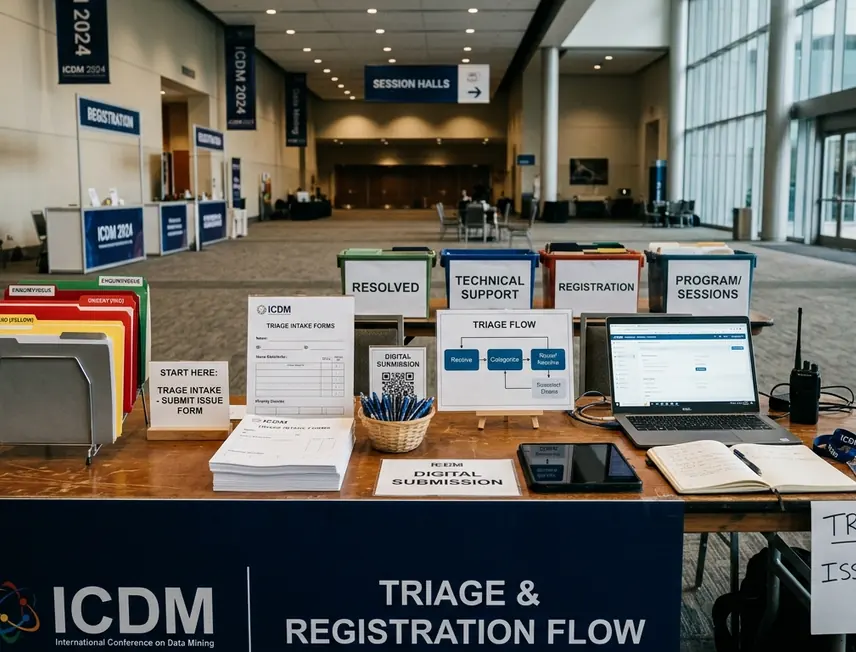
The track chairs established a triage process where papers are first screened for a clear network systems contribution. The committee initially considered merging all networking papers into the general IT track, but maintaining a dedicated focus ensures higher quality feedback. We allocate 3 to 5 days for the initial desk-reject screening phase before moving papers into full peer review.
In-scope submissions tackle the mechanics of data movement directly. Examples include protocol design with reproducible evaluation, network measurement studies with clear methodology, edge and cloud communication architectures, and distributed systems performance studies. These papers treat the network as the primary subject of investigation.
Conditionally in-scope submissions often sit at the boundary of disciplines. Application papers where the communications layer is secondary but technically evaluated fit here. Surveys that provide a rigorous taxonomy and research gap analysis are also welcome, as are implementation papers with limited theory but strong systems validation. Every submission that passes screening is guaranteed a minimum of 3 independent reviewer scores.
Evaluation Expectations for Communications and Network Systems Research
Systems papers are judged heavily on evaluation design. Reviewers assess evaluation rigor by checking if the chosen methodology aligns with the paper's claims, specifically looking for documented baseline comparisons and reproducible simulation parameters. The acceptability of simulation versus physical testbed evaluation depends entirely on whether the research claims address theoretical protocol limits or real-world hardware deployment constraints.
Common evaluation methods include simulation, emulation, testbed deployment, prototype implementation, trace-driven analysis, formal modeling, and comparative benchmarking. Trace-driven analysis provides high fidelity for the specific network conditions captured, but struggles to predict system behavior under novel congestion patterns or different topological scales. Analysis of samples suggests that 120 to 300 seconds of simulated network time is sufficient for steady-state congestion analysis in most standard topologies.
Metrics must be chosen carefully and justified. We look for qualitative and quantitative assessments of latency, throughput, packet loss, jitter, reliability, energy consumption, scalability, fairness, privacy exposure, and computational overhead. Experimental data, across repeated measurements, indicates packet loss rates measured at 10^-4 to 10^-6 thresholds for reliability claims are standard expectations for industrial IoT submissions.
Where Communications Research Intersects Data Mining, AI, and IT Systems
The DMCIT 2024 context is distinctive because communications topics are evaluated not only as networking problems, but also as enablers of data-intensive and intelligent systems. The editorial board designed cross-track keywords to flag submissions that bridge domains, prompting the assignment of at least one reviewer from the data mining pool and one from the communications pool. We allow 48 to 72 hours for cross-track reviewer reassignment to ensure strong expertise matching.
Intersections with data mining frequently appear in traffic classification, anomaly detection, network telemetry mining, intrusion pattern recognition, and adaptive resource prediction. These papers must handle realistic constraints, such as bandwidth limits ranging from 250 kbps in LPWANs to 10 Gbps in enterprise backbones.
Machine learning intersections are equally prominent. We see strong submissions focusing on intelligent routing, link quality prediction, spectrum sensing, load balancing, and adaptive edge orchestration. In these cases, the network is both the source of the training data and the environment where the resulting model must execute.
Scope, Limitations, and Responsible Claims
The steering committee drafted specific limitations to prevent authors from relying solely on standards compliance as proof of novelty. While standards define technical baselines, they do not determine conference acceptance. You must explicitly articulate the research gap your work addresses. While network simulation tools provide controlled environments, they inherently abstract away physical layer interference anomalies.
Foundational texts provide historical grounding but should not be presented as the final state of the field. We frequently see historical baselines dating back to 1988 for foundational congestion control comparisons. These are useful for context, but your evaluation must compare against modern, state-of-the-art approaches.
A common failure case: A paper claiming 'improved efficiency' without defining whether the metric is energy consumption per bit, computational overhead, or spectral efficiency. Vague claims lead to poor reviewer scores. If a reviewer points out unsupported performance claims, we provide 14 to 21 days for authors to revise and clarify these metrics during the rebuttal phase.
Important: Never claim a protocol is "proven" secure or "guaranteed" to deliver zero packet loss based solely on a limited simulation. Frame your claims within the exact boundaries of your tested parameters.
Practical Guidance for Authors Preparing a Submission
Frame your paper around a precise communications problem. Whether you are addressing congestion, reliability, mobility, interoperability, privacy, resource allocation, or distributed coordination, state the problem immediately. Abstracts limited to 150 to 250 words ensure concise problem statements and help chairs route the paper accurately.
We recommend a highly structured approach to your manuscript. Begin with a clear problem statement, followed by related standards or prior work. Detail your proposed method and system model. Describe your evaluation environment thoroughly. Present your results, openly discuss limitations, and conclude with implications for data-driven or IT systems. If you are submitting a physical testbed paper, be aware that 4 to 6 months of experimental data collection is typically expected to capture sufficient environmental variance.
Bottom Line: A strong network systems submission makes both its technical mechanism and its evaluation boundary explicit. Tell us exactly what you built, how you tested it, and where it breaks.