Establishing a Transparent Evidence Chain
A complete reproducibility package consolidates five to seven distinct components, including data provenance, executable code, and environment specifications. Authors assemble these archives to let reviewers inspect exactly how specific claims were produced. The objective centers entirely on creating a transparent, inspectable evidence trail. Floating-point variations make guaranteeing bit-for-bit identical outputs across every conceivable hardware setup nearly impossible, so the emphasis shifts to verifiable processes.
Consider the mechanics of a standard 12- to 18-hour training run. A missing random seed can cause significant variance in loss convergence over that duration. When reviewers encounter this variance, they lose the ability to verify the baseline performance reported in the manuscript. By supplying the exact configurations, environment specifications, and execution logs, authors provide the connected evidence behind the paper. Reviewers gain the context needed to evaluate the methodology, even if their local hardware produces slight numerical deviations.
Tracing Manuscript Figures to Source Commands
Authors systematically extract each figure and table from the manuscript to build a comprehensive traceability matrix. This mapping process typically requires three to five days of dedicated effort prior to the submission deadline. The resulting claim-to-artifact mapping matrix traces back four to six primary figures and their underlying preprocessing scripts directly to specific command-line entries.
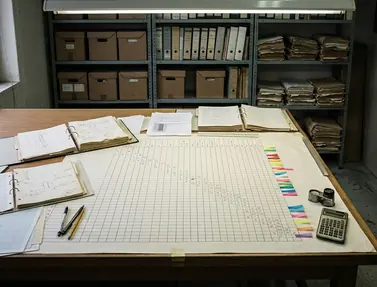
Every principal figure, benchmark comparison, ablation study, and preprocessing decision requires a documented lineage. For every claim, identify the input dataset, configuration file, entry command, expected output location, and validation method. This structured approach eliminates the guesswork for evaluators navigating a complex repository.
Separate the artifacts that support computational reproducibility from optional materials intended for broader replication or reuse. Reviewers need a clear, unobstructed path from the reported results in the PDF to the exact script that generated them. Bundling exploratory scripts or deprecated models with the core reproducibility package only obscures the primary evidence chain.
Handling Restricted Datasets Safely
Many submissions rely on proprietary or sensitive information that cannot be distributed publicly. De-identification reviews involve scanning roughly 15 to 20 distinct metadata fields and free-text columns. The manual and automated auditing of these quasi-identifiers commonly takes 48 to 72 hours to complete. When redistribution is allowed, authors provide stable acquisition instructions and scripts that transform raw inputs into the analysis-ready form.
When data cannot be shared, authors establish a protocol for handling restricted data by generating a structurally representative synthetic sample that mirrors the original schema. This allows reviewers to execute the preprocessing pipeline safely and verify the code's mechanics. Providing a synthetic dataset satisfies structural reproducibility requirements, though it cannot be used to validate the exact accuracy metrics reported in the original paper. This limitation is an accepted trade-off in privacy-aware research.
Synthetic Data Tip: Supply a full feature dictionary, preprocessing code, and controlled-access instructions alongside your synthetic sample to give reviewers maximum visibility into your data pipeline.
Include a data manifest recording filenames or logical tables, provenance, permitted uses, preprocessing stages, label definitions, and integrity checks. Clear documentation of the data pipeline builds confidence in the final results, even when the raw inputs remain locked behind institutional firewalls.
Orchestrating a Linear Execution Path
Reviewers evaluate dozens of papers and rarely have the time to decipher fragmented execution instructions. Authors implement a single task runner to orchestrate the workflow, providing reviewers with a linear, documented execution path for the entire pipeline. Provide one documented entry point, such as a shell script, notebook sequence, or workflow command, rather than requiring reviewers to reconstruct the command order manually.
A standard verification run should finish within roughly 15 to 20 minutes. To achieve this, the smoke test utilizes a reduced batch size of 16 to 32 samples to demonstrate the pipeline's functionality without heavy compute. This rapid feedback loop confirms that the environment is configured correctly before initiating longer, resource-intensive processes.
Use a predictable repository structure for source code, configurations, data instructions, experiment scripts, tests, logs, and generated outputs. Freeze experiment configurations separately from implementation code. Record split definitions, model settings, stopping criteria, and evaluation parameters in dedicated files. This separation allows reviewers to inspect the experimental setup without wading through thousands of lines of application logic.
Freezing the Computational Environment
The environment is captured by freezing dependencies into a lockfile immediately after a successful training run. This preserves the exact state of the system libraries used for the reported results. Environment specifications capture exact versions for what is often 40 to 50 core dependencies, including specific driver versions. These dependencies are recorded and locked during the final 7- to 10-day experiment phase.
Provide the dependency format native to the project, such as an environment specification, container recipe, or package manifest. Record language, library, operating-system, and hardware dependencies that materially affect execution or numerical behavior. A generic list of top-level packages is insufficient for reproducing complex distributed systems or wireless protocol simulations.
Preserve machine-readable logs containing invoked configurations, completion status, output paths, and errors. These logs serve as a secondary evidence trail, confirming that the reported experiments were actually executed as described. Scrub usernames, hostnames, credentials, and identifying directory paths from these logs before inclusion in the final package.
Auditing Metadata for Anonymous Review
Authors conduct a systematic metadata audit, stripping absolute local paths and institutional affiliations from all configuration files and document properties prior to generating the final archive. The anonymity audit requires a thorough review of some 10 to 15 configuration files and log outputs. This scrubbing process typically takes two to four hours to ensure no institutional identifiers or author names leak to the review committee.
Establish a strict double-anonymous metadata scrubbing perimeter around the repository. Audit repository history, account names, author metadata, ORCID identifiers, acknowledgments, license ownership lines, cloud addresses, and embedded document properties. A single overlooked absolute path pointing to a user directory can compromise the integrity of the double-anonymous review process.
Structure the README around prerequisites, data preparation, a minimal verification run, the full workflow, expected artifact locations, and troubleshooting. Offer a short smoke test that verifies installation and file flow before a reviewer attempts expensive experiments. Clear, anonymous instructions demonstrate respect for the reviewer's time and expertise.
Bibliography
Drawing on the 2020 ACM artifact review framework, foundational reproducibility standards provide a shared vocabulary for authors. Aligning submission guidelines with established academic computing standards ensures consistency across the discipline.
- Association for Computing Machinery. "Artifact Review and Badging Version 1.1." 2020.
- National Institute of Standards and Technology. "De-Identification of Personal Information." 2015.
- PLOS Computational Biology. "Ten Simple Rules for Reproducible Computational Research." 2013.
Validating the Archive Through Rehearsal
An author provisions a fresh virtual machine specifically to test the reviewer instructions from start to finish. This ensures the workflow succeeds without relying on pre-existing local caches or undocumented environment variables. A clean-clone rehearsal spans a session of two to three hours. During that session, the author downloads the anonymous archive, roughly 50MB to 500MB in size, and executes the smoke test on a newly provisioned environment.
Record every undocumented assumption uncovered by the rehearsal. This includes missing system packages, implicit paths, manual downloads, unavailable credentials, and unexplained configuration choices. Confirm that the archive opens correctly, links do not reveal identity, restricted data are absent, checksums match, and the README reflects the submitted version.
Provision a blank virtual machine today, download your finalized submission archive, and execute the exact sequence of commands listed in your README to verify the pipeline runs independently.